The Bronx · Since 1953
Liebman’s Delicatessen
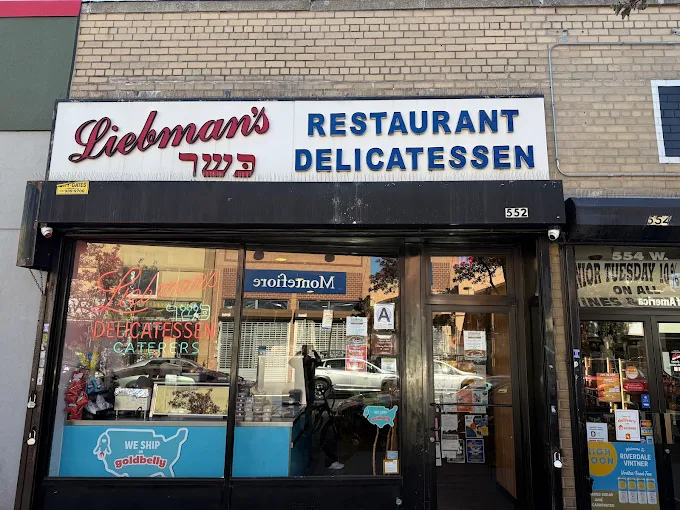
Open in Riverdale since 1953, Liebman’s Delicatessen is the Bronx’s last remaining kosher deli, serving house-cured pastrami, matzo ball soup and generations of loyal New Yorkers.
№ 0027
The story
The Last Kosher Deli in the Bronx
On a quiet stretch of West 235th Street in Riverdale, Liebman’s Delicatessen keeps alive a version of New York that has nearly disappeared.
Inside, the booths are padded, the portions are generous and the menu reads like a living archive of Jewish New York: pastrami and corned beef on rye, matzo ball soup, chopped liver, knishes, stuffed cabbage, kishka and bottles of Dr. Brown’s Cel-Ray.
Liebman’s is not a recreation of an old-fashioned deli. It is the real thing.
Opened in 1953, it has outlived more than 100 Jewish delis that once operated across the Bronx. Today, it is recognized as the borough’s last remaining kosher delicatessen—a neighborhood restaurant that has continued serving generations of the same families while much of the city around it has changed.
A Bronx Deli Since 1953
Joe Liebman opened the original delicatessen on Johnson Avenue in 1953. At the time, the Bronx had a large Jewish population and Jewish delis could be found throughout the borough.
Competition was everywhere, but Liebman believed that quality food and friendly service would give his restaurant a future. More than seven decades later, the deli that bears his name is still serving customers from its original Riverdale neighborhood.
The story entered a new chapter in 1980, when Israeli immigrant Joseph Dekel acquired the restaurant. Dekel renovated the space but made a deliberate decision not to reinvent its food. Instead, he preserved the deli’s established recipes and traditions.
After Joseph died in 2002, his 24-year-old son, Yuval Dekel, took over the business. It was an unexpected transition. Yuval had worked as an artisan baker and played drums in the Bronx heavy-metal band Irate before becoming the next steward of one of New York’s most traditional Jewish restaurants.
Yuval retained the old recipes while bringing his own skills into the kitchen. His baking background appears in the fresh challah and babka, while his work refining the curing process helped make Liebman’s pastrami the restaurant’s signature.
The deli remains under his direction today, serving the children, grandchildren and great-grandchildren of its original customers. Liebman’s official history describes it as both a New York City institution and a Bronx landmark.
A Dining Room That Still Feels Like a Neighborhood Deli
Walking into Liebman’s feels less like stepping into a themed restaurant and more like entering a neighborhood dining room that never felt the need to follow trends.
The atmosphere is comfortable and unpretentious. Classic booths line the room, an old-school counter anchors the space and the menu stretches far beyond the handful of oversized sandwiches for which New York delis are usually known.
Regular customers come for familiar meals, not culinary theater. Lunch can mean a bowl of chicken soup, a frankfurter or a pastrami sandwich. Dinner might be stuffed cabbage, brisket with gravy or Hungarian goulash. Families gather around plates designed to be shared, debated and carried home in a takeout container.
That continuity is central to Liebman’s identity. It does not simply preserve recipes; it preserves the social role of the neighborhood deli as a place where people eat, talk and return often enough to become part of the restaurant’s history.
The Pastrami on Rye
For a first visit, begin with the pastrami.
Liebman’s cures its pastrami in-house and slices it thin, distributing the seasoned outer crust throughout the sandwich. The result is tender, smoky and richly flavored without relying on an unnecessarily complicated presentation.
Ordering it on rye with deli mustard is the simplest way to understand why the sandwich has remained the centerpiece of the restaurant.
The corned beef is another classic choice, but visitors who cannot decide between the two can order Liebman’s signature pastrami and corned beef combination. It comes on rye with Russian dressing and coleslaw, bringing together two of the deli’s defining meats in one substantial sandwich.
Those looking for something even heartier can try the Liebman’s Favorite: an open-faced serving of pastrami and corned beef accompanied by fried potatoes, kishka and gravy.
More Than a Pastrami Destination
The pastrami attracts attention, but Liebman’s is most interesting when the meal extends beyond the sandwich.
The old-fashioned chicken soup can be ordered with noodles, a matzo ball or kreplach. It is the kind of restorative, deeply familiar dish that has helped define the Jewish deli experience for generations.
The stuffed cabbage is filled with ground beef and rice and served in a sweet-and-sour raisin gravy. Chopped chicken liver arrives with tomato, red onion, onion marmalade and rye. Other traditional options include gefilte fish, kishka, fried kreplach and beef tongue.
Potato latkes, served with applesauce, make an excellent addition to the table. Knishes are available with potato, kasha, spinach or meat fillings, offering another route into the deli’s more traditional side.
Liebman’s also serves full dinners, including brisket, corned beef and cabbage, stuffed peppers, meatloaf and Hungarian goulash. These dishes distinguish it from sandwich counters that use the word “deli” but offer only cold cuts and heroes.
What Anthony Bourdain Ordered
Liebman’s received wider attention when Anthony Bourdain visited during the Bronx episode of Parts Unknown.
Bourdain’s table included hot pastrami, chopped liver on toast, potato pancakes with applesauce, pickles and a bottle of Dr. Brown’s Cel-Ray. It remains a useful ordering blueprint for anyone who wants to experience several sides of the restaurant in a single visit. His stop is documented by the official Explore Parts Unknown Bronx guide.
But Liebman’s significance does not come from celebrity approval. Its story is built more on the customers who have returned for decades than the visitors who came once with a television crew.
What to Order at Liebman’s
Pastrami on Rye
The essential first order. Keep it simple with deli mustard, or choose one of the restaurant’s combination sandwiches.
Matzo Ball Soup
Old-fashioned chicken soup with a matzo ball is one of the most traditional and comforting dishes on the menu.
Stuffed Cabbage
Ground beef and rice wrapped in cabbage and served with sweet-and-sour raisin gravy. It represents the home-style side of Liebman’s cooking.
Potato Latkes
Crisp potato pancakes served with applesauce. Ideal for sharing alongside a sandwich.
Chopped Chicken Liver
A classic deli appetizer served with rye, tomato, red onion and onion marmalade.
Knish
Choose potato for the traditional experience, or try kasha, spinach or meat.
Dr. Brown’s Cel-Ray or Old-Fashioned Seltzer
Complete the meal with the celery-flavored soda associated with generations of New York deli counters—or order a large glass bottle of seltzer for the table.
Why Liebman’s Matters
New York still has famous Jewish delis, but very few remain in the neighborhoods where this dining tradition once formed part of daily life.
That makes Liebman’s more than a destination for pastrami. It is the surviving link to a period when the Bronx was home to a dense network of Jewish bakeries, appetizing stores, butcher shops and kosher delicatessens.
Liebman’s has survived by preserving that identity without allowing it to become frozen in time. It now offers delivery, catering and nationwide shipping, and the family opened a second location in Ardsley, Westchester, in 2024. Yet the original Riverdale restaurant remains the heart of the story.
The food is substantial, but the history carried by it is even larger. Every bowl of matzo ball soup and every pastrami sandwich connects the dining room to the generations who sat there before.
In a city that is always replacing itself, Liebman’s continues to do something increasingly rare: remain recognizably itself.