Manhattan · Since 1888
Katz’s Delicatessen
Discover Katz’s Delicatessen, its legendary pastrami, remarkable history, what to order, and essential tips for visiting this Lower East Side icon.
№ 0011
The story
Some restaurants serve food. Others preserve a piece of the city around them.
Katz’s Delicatessen belongs firmly in the second category.
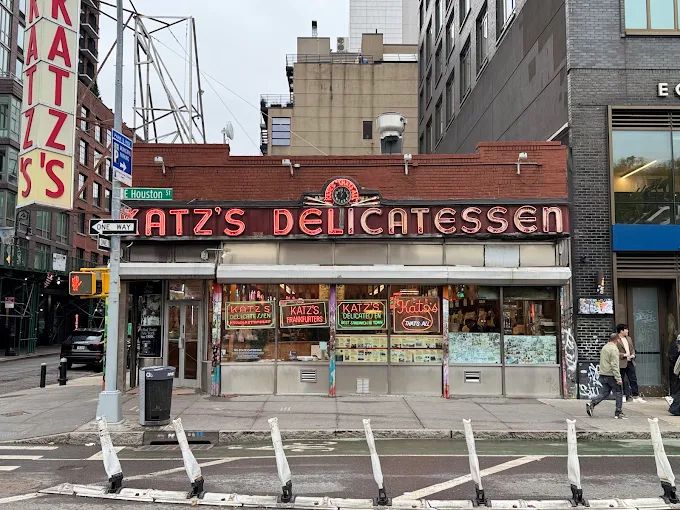
Standing at the corner of East Houston and Ludlow Streets, Katz’s is one of New York City’s most recognizable restaurants. Its neon storefront, crowded dining room, ticket-based ordering system and towering pastrami sandwiches have become part of the visual language of the Lower East Side.
Yet Katz’s is more than a famous place to eat or a stop on a movie-location tour. It is a living connection to the neighborhood’s immigrant history, the development of New York’s Jewish delicatessen tradition and a style of restaurant that has largely disappeared from the city.
For anyone trying to understand New York through its delis, Katz’s is an essential place to begin.
From an Immigrant Neighborhood Deli to a New York Institution
Katz’s traces its history to 1888, when the Iceland brothers established a small delicatessen on Ludlow Street. Willy Katz joined the business in 1903, prompting the name to change to Iceland & Katz. Willy’s cousin Benny Katz arrived several years later, and after the brothers bought out the original owners, Katz’s Delicatessen took shape.
Harry Tarowsky became a partner in 1917, beginning a relationship between the Katz and Tarowsky families that would continue for generations.
The deli eventually moved across the street because of subway construction. According to Katz’s official history, the Houston Street side of the property initially remained an open lot used to store barrels of meat and pickles. The familiar storefront was completed between 1946 and 1949.
These details are more than restaurant trivia. They reveal how closely the story of Katz’s is tied to the transformation of the Lower East Side.
During the late 19th and early 20th centuries, the neighborhood became home to large numbers of Jewish immigrants from Eastern Europe. Delicatessens provided familiar foods, but they also served as informal gathering places where people could meet, exchange news and maintain a sense of community in a new country.
Katz’s became one of those neighborhood institutions. Residents gathered there for meals, and Friday nights were once associated with the deli’s tradition of serving franks and beans.
The nearby Yiddish theater district brought another group of regulars. Actors, singers and comedians from the theaters on Second Avenue and Houston Street frequently ate at Katz’s. The photographs of entertainers, politicians, athletes and other famous visitors now covering the walls continue that connection between the deli and New York public life.
“Send a Salami to Your Boy in the Army”
One of Katz’s most enduring slogans originated during World War II.
With the owners’ sons serving in the military, the families regularly shipped food to them overseas. The practice inspired the phrase “Send a Salami to Your Boy in the Army,” which became closely associated with the deli.
The slogan can still be seen inside Katz’s today. What began as a family gesture became a small but memorable example of how neighborhood businesses participated in the lives of their communities during the war.
The Pastrami That Made Katz’s Famous
Katz’s has a large menu, but its reputation rests primarily on one order: hot pastrami on rye with mustard.
The sandwich appears simple. Two slices of rye bread hold a generous pile of warm, hand-carved meat, usually accompanied by mustard and pickles. But the process behind the pastrami takes patience and considerable preparation.
Katz’s makes its pastrami in-house using beef navel, a rich and naturally fatty cut taken from the underside of the animal. The meat is submerged in a seasoned brine for weeks before being coated in a traditional spice mixture.
It is then slowly smoked in the deli’s custom smokers. Before service, the pastrami is boiled for two to three hours to tenderize it further and remove excess salt. It is finally held warm in steam tables until one of Katz’s cutters carves it by hand for each customer.
The complete process—brining, seasoning, smoking, boiling, steaming and carving—produces pastrami with several distinct layers of flavor. The exterior has a peppery, seasoned bark, while the inside remains smoky, rich and tender. The fat running through the meat is not an imperfection; it is a central part of the texture and flavor.
According to Katz’s, every piece of its pastrami continues to be prepared this way rather than arriving as a finished product from a third-party deli-meat supplier. Katz’s explanation of its pastrami process offers a closer look at each stage.
What to Order at Katz’s
1. Pastrami on Rye
For a first visit, the classic pastrami sandwich is the natural choice.
Order it on rye with mustard and choose the standard “juicy” cut unless you strongly prefer lean meat. The fattier sections generally provide the tenderness and full flavor for which Katz’s pastrami is known.
The sandwich is intentionally straightforward. It does not need cheese, elaborate toppings or a complicated sauce. Pastrami, rye and mustard are enough.
2. Corned Beef
Katz’s corned beef is slow-brined and carved by hand at the counter. It has a milder, less smoky character than the pastrami but remains one of the deli’s most important traditional offerings.
Visitors who want to compare the two can order a combination sandwich or share separate sandwiches with a group.
3. The Reuben
Katz’s Reuben combines corned beef—or pastrami, if requested—with Swiss cheese, sauerkraut and Reuben dressing on rye.
It is richer and more elaborate than the classic pastrami sandwich. It is also one reason visitors should understand that Katz’s is kosher-style rather than strictly kosher: the restaurant serves meat and dairy together.
4. Matzo Ball Soup
The matzo ball soup provides a comforting counterpart to the deli’s enormous meat sandwiches. A light matzo ball is served in chicken broth, making it one of the best options for experiencing another side of the Jewish American deli tradition.
For a more manageable meal, Katz’s offers combinations that pair soup with half a sandwich.
5. Potato Knish or Latkes
A square potato knish is one of the most traditional accompaniments on the menu. Katz’s also serves potato latkes with applesauce and sour cream.
Both are substantial, so consider sharing if you are already ordering a full sandwich.
6. Pickles and a Dr. Brown’s Soda
The pickles are part of the complete Katz’s experience. Pair the meal with a Dr. Brown’s soda—particularly Cel-Ray, black cherry or cream soda—for a classic New York deli combination.
How the Katz’s Ticket System Works
Katz’s can feel confusing on a first visit, especially during a busy lunch period. Its old-fashioned ticket system is part of the experience, but it helps to know what to expect.
Each customer receives a paper ticket upon entering. Keep it with you throughout the visit.
For counter service, walk toward the long carving counter and choose a line in front of one of the cutters. Tell the cutter what you want, and your order will be recorded on your ticket. Other items and drinks may be ordered from separate sections of the counter.
After collecting your food, find an available self-service table. When you are ready to leave, bring your ticket to the cashier near the exit and pay the recorded total.
Do not throw away or misplace the ticket—even an unused ticket must be returned when leaving.
There is also a table-service section, but ordering directly from the cutters provides the most characteristic Katz’s experience.
A Deli Frozen in Time—Without Becoming a Museum
Inside Katz’s, almost every surface appears to carry a story.
Photographs cover the walls. Signs hang above the counter. The dining room is loud, crowded and functional rather than carefully styled. Cutters work rapidly behind the counter while customers balance trays, search for seats and attempt to navigate the ticket system.
It can feel chaotic, but that energy is central to the restaurant.
Katz’s has avoided turning itself into a polished imitation of an old New York deli. It remains a high-volume working restaurant. The room feels historic because it has continued to perform its original purpose, not because it has been redesigned to look vintage.
Ownership changed in 1988, when longtime family friends Martin Dell, Alan Dell and Fred Austin joined the business. Alan Dell’s son Jake began working at Katz’s in 2009 and currently oversees its operations, continuing the deli’s multigenerational management tradition.
The Famous When Harry Met Sally… Table
Katz’s reached an entirely new audience after appearing in the 1989 romantic comedy When Harry Met Sally…
The restaurant was the setting for the movie’s famous scene in which Meg Ryan’s character demonstrates how convincingly a woman can fake pleasure. A customer at the next table then delivers the now-famous line, “I’ll have what she’s having.”
The table used in the scene remains marked inside the dining room, and it has become one of the restaurant’s most photographed features.
Although the film helped turn Katz’s into an international attraction, the deli’s importance predates Hollywood. The movie did not create Katz’s cultural significance—it introduced a much larger audience to a restaurant that had already been part of New York life for approximately a century.
The Historic Ludlow Room Returns
In May 2026, Katz’s reopened a part of the restaurant that had been closed to diners since 1949.
Known as the Ludlow Room, the 68-seat space had spent decades serving as a large walk-in refrigerator used to store pastrami, corned beef and brisket. A yearlong restoration returned the room to public use while preserving historic elements such as its original tin ceiling.
The renovated space incorporates period-inspired flooring, lighting, wainscoting and photographs showing earlier versions of Katz’s. It can also be used for private events, with a dedicated cutter available to hand-carve meat for guests.
According to owner Jake Dell, the room was designed to resemble the Katz’s experienced by customers approximately 80 years ago. Its reopening represents one of the most significant physical changes to the deli in recent history. People reported on the restoration and reopening in May 2026.
Essential Tips for Visiting Katz’s
- Visit before the main lunch or dinner rush if you want a calmer experience. Weekends and holiday periods can produce long lines.
- Do not lose the ticket given to you at the entrance.
- For the classic experience, order directly from a cutter at the counter.
- Choose the standard juicy pastrami unless you have a strong preference for lean meat.
- Expect large portions. Sharing a sandwich and a few sides can be enough for two lighter eaters.
- Katz’s is casual, busy and often loud. That atmosphere is part of its identity.
- Pronounce Houston Street as “HOW-stun,” not like the city in Texas.
- Check the official menu and hours before visiting, as prices and schedules can change.
Hours and Transportation
According to the restaurant’s official location page, its current regular hours are:
- Monday–Thursday: 8:00 a.m.–11:00 p.m.
- Friday: Opens at 8:00 a.m.
- Saturday: Open 24 hours
- Sunday: Open until 11:00 p.m.
The nearest subway options include:
- F train: Second Avenue
- F, M, J or Z trains: Delancey Street–Essex Street
Always confirm current hours directly with the restaurant before making a special trip.
Why Katz’s Matters
Katz’s is frequently described as a tourist attraction, but that description is incomplete.
Tourists certainly visit, and the restaurant’s fame can create long lines. Yet dismissing Katz’s as a tourist destination ignores what has survived inside it: hand-carved meats, a traditional counter-service system, Jewish American comfort food and more than a century of Lower East Side history.
Many of the neighborhood’s historic delicatessens, bakeries, theaters and gathering places have disappeared. Katz’s remains—not entirely unchanged, but still recognizably connected to the culture that created it.
The pastrami may be the reason most people enter. The sense of continuity is what makes the restaurant important.
Katz’s Delicatessen does not simply recreate old New York. It is one of the places where old New York is still working.